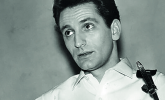


He was never a chat-show fixture, regaling the hapless audience with dire golfing anecdotes. He often seemed ill at ease when introducing his programmes.
By the 1980s, many younger comedians derided Hill’s output, but Anthony Burgess believed ‘Orwell would have loved him’, and, in 1991, he received the Charlie Chaplin International Award for Comedy.
Alfred Hawthorne Hill was born on 21st January 1924 in Southampton, where his father managed a surgical-appliances shop. Mark Lewisohn’s indispensable biography Funny, Peculiar makes the Hill family sound like a British Lion comedy film, with Lionel Jeffries as the stern and parsimonious Hill senior.
After leaving Taunton’s School in Southampton, Hill tried a variety of jobs – including as a milkman – and was a dance-band guitarist and crooner in the evenings. At the age of 16, he headed for London in an attempt to become a variety comedian.
War service in REME interrupted his nascent show-business career. After the war, he adopted the stage name Benny.
For the next few years, there were the familiar rounds of grim venues. He even posed for a body-building magazine to earn a few shillings. At one point, Hill served as Reg Varney’s straight man and suffered the ignominy of being booed off during his solo spot.
But Hill persevered, making his TV debut in 1950, with The Benny Hill Show starting in 1955. He co-wrote the scripts with the former Special Branch officer Dave Freeman. Hill proved ideal for the small screen, giving conspiratorial glances to the camera and exploiting the medium.
A spoof of Juke Box Jury, in which he played David Jacobs, all four panellists and various audience members, was a tour de force. In 1964, Hill created The Lonely One, a spoof documentary about a young hooligan who aims to be respected – ‘like Lord Sutch’.
Observer described Hill as ‘the first star comedian to be created by television’. Television success allowed him to abandon stage work and hide behind his characters.>span class="Apple-converted-space">
He hoped his small-screen fame would result in film stardom, and his cinematic debut in Ealing’s 1956 Who Done It? showed his considerable potential as a light-comedy leading man.
Yet British cinema never seemed to appreciate Hill’s range, despite Light Up the Sky! (1960) and Chitty Chitty Bang Bang (1968) displaying his talents as a character actor.
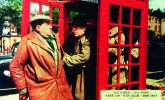
The Italian Job. He helped to create the character of the disturbed Professor Simon Peach, who was obsessed with large women, and his is by far the film’s best performance.>span class="Apple-converted-space">
span class="Apple-converted-space">
Hill stated, ‘I get a kick out of taking ordinary girls to places they would not normally visit.’ In practice, this often meant a supper of poached eggs and gifts of cheap lingerie and perfume which Hill acquired wholesale. He preferred ladies to address him as ‘Mr Hill’ while pleasing him, telling his friend Bob Monkhouse, ‘It’s respectful.’
At the time of The Italian Job’s release, Hill had transferred to Thames Television with his straight man Henry McGee and his two main stooges, Jackie Wright and Bob Todd, whose finest hour was impersonating an inebriated Johnnie Cradock.
One inducement was the chance to make films. The semi-silent Eddie in August, screened in 1970, was witty and imaginative, reflecting Hill’s admiration of Jacques Tati.
But audiences seemed confused and, regretfully, he never attempted to create such autobiographical work again. Nor was his idea of dramatising The Good Soldier Schweik ever realised.
The Original Chinese Waiter to create the character Chow-Mein. The American comedian later expressed a wish to strangle Hill.>span class="Apple-converted-space">
But, at its best, The Benny Hill Show was a fascinating mélange of a Donald McGill postcard and the silent French comedy of Pierre Étaix. One sketch has middle-aged voyeurs disguised as tree trunks so they can spy on a courting couple. A 1970 show is especially treasurable for Hill’s rendition of Ernie, his self-penned ballad about the fastest milkman in the West. This homage to his old job became the 1971 Christmas number one.
In 1979, Thames sold re-edited versions of his shows to US television – eventually, 127 countries would screen The Benny Hill Show. This was also the year the producer Dennis Kirkland introduced the Hill’s Angels dance troupe. It was a move reflecting Hill’s belief that his programmes were the nearest shows on television to the touring revues of his youth.
His show also moved towards ‘comedy without words’, although one of Hill’s strengths was verbal interplay with such esteemed actors as Patricia Hayes and even Paul Eddington.
As the 1980s progressed, The Benny Hill Show deteriorated into a tired end-of-the-pier show.
In 1987, Ben Elton told the Daily Telegraph, ‘I’m not saying Benny Hill’s a bad man’ but ‘it does not behove a television company to end a show every week with a dirty old man tearing the clothes off three nubile girls’.
The older comedian could argue that his screen character was an inadequate coward who fled irate females, but his image now appeared faintly seedy.
Meanwhile, the tabloid press was fascinated by why a comedian worth several million pounds lived in a dilapidated semi-detached villa.
Hill inherited the family home and lived in Shirley, Southampton’s answer to East Cheam, when he was between London flats. Chez Hill was the fortress of a man who once dined from Second World War tinned food without labels – ‘It’s interesting to find out what’s there’ – just as his programme seemed a relic from an era of Brylcreem and Woodbines. In his show, too, Hill, indulged by his producer, did not seem to relish change.
When Hill died of a heart attack on 20th April 1992, aged 68, the innovative and versatile comedian-writer-musician of the BBC era was almost forgotten.
A viewing of his early material is well worth it. Look out for The Visitor, a 25-minute playlet with Hill as a faintly sinister yokel constantly imposing himself on reluctant London acquaintances. His ‘breakfast cha-cha’ in 1965 was created 11 years before the famous Morecambe and Wise routine.
Perhaps Hill’s finest hour was in a 1964 ITV adaptation of A Midsummer Night’s Dream, where he was perfectly cast as a Hampshire-accented Bottom.
Philip Purser of the Sunday Telegraph, while approving of the performance, regarded his top billing as ‘putting the arse before the court’.
Shortly afterwards, the critic received a ‘wildly enthusiastic postcard’ from Hill.
The last Benny Hill Show aired on 1st May 1989. Thames’s firing of Hill that year is the subject of many an article about ‘the death of comedy’, but the comic was in poor health, his shows were expensive, and the company had enough footage to satisfy overseas markets.
Hill, not unreasonably, thought it would have been nice to have received ‘a pat on the back’.